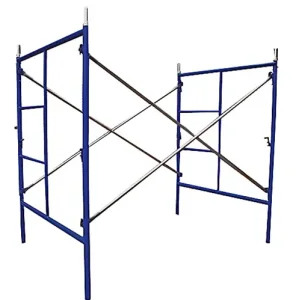
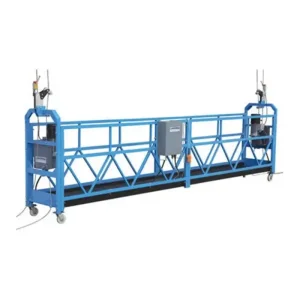
Leading the Global Market in High-Load Metal Structures and Scaffolding Innovation
Zhuozhan Group is a diversified and innovative enterprise that seamlessly integrates scientific research, manufacturing, and sales. With a robust portfolio of subsidiaries, including Laoting Zhuozhan International Trade Co., Ltd. and Hebei Shuangyang Metal Structure Co., Ltd., Zhuozhan Group has firmly established itself as a key player in the construction and manufacturing industries. Deeply cultivated in the metal structuring sector for over 12 years, the group collaborates with over 150 leading manufacturers across 30+ provinces in China.
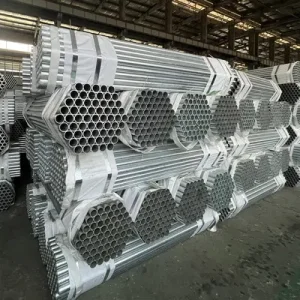
Our manufacturing powerhouse, Hebei Shuangyang Metal Structure Co., Ltd. (founded in 2014), operates standard modern workshops occupying 13,132.68 square meters with a dedicated construction footprint of 7,124.58 square meters. Equipped with more than 150 sets of advanced heavy metallurgy machinery, Shuangyang possesses massive scale capacity: an annual output of 300,000 tons of steel pipes, 1,000,000 tons of high-load industrial scaffolding systems, and 400,000 tons of adjustable steel shoring supports.
Analyzing global design transitions, regulatory frameworks, and smart structural methodologies
The global industrial scaffolding market has undergone an aggressive shift toward modular, high-yield structural components. The traditional pipe-and-clamp setups are rapidly being phased out due to rising labor costs, tighter construction deadlines, and stricter zero-harm safety initiatives on modern construction sites.
Today's mega-infrastructure projects—such as petrochemical refineries, offshore wind hubs, marine ports, and deep-span transit bridges—require specialized scaffolding configurations that boast structural rigidity and immense loading parameters. In response, modern engineering has standardly adopted Q355B low-alloy, high-strength structural steel as the primary metal substrate.
Key Trend: Smart scaffolding design integrating BIM (Building Information Modeling) and FEM (Finite Element Method) analysis ensures load limits are simulated long before materials arrive on site.
Enterprise-level contractors and EPC (Engineering, Procurement, and Construction) companies emphasize three strict values during structural procurement:
Leveraging deep industrial clusters and seamless port logistics for high-volume execution
As a leading Chinese direct-source factory, Hebei Shuangyang operates a 40,000-square-meter facility with an annual manufacturing volume exceeding 200,000 tons of structural steel units. Over 20 internal engineering designers draft project-specific structural schemes.
Our strategically chosen location features convenient transit routes adjacent to three of China’s major trade shipping hubs: Jingtang Port, Tianjin Port, and Caofeidian Port. This ensures rapid material movements, low local freight costs, and prompt international ocean dispatch.
With nearly 100 industrial application scenarios—ranging from commercial civil developments and high-rise core walls to aerospace platforms, heavy logistics docks, and complex shipbuilding shoring scaffolding setups.
Deep dive comparison of load thresholds, installation cycle times, and metallurgy performance
| Performance Index | Zhuozhan High-Load Scaffolding (Q355B Steel) | Conventional Scaffolding Systems (Q235 Steel) |
|---|---|---|
| Load Capacity Per Standard | Up to 10 Metric Tons (1.5x ordinary capacity) | Approx. 6.5 Metric Tons |
| Erection Speed | 150 - 300 square meters per man-day (3-5x faster) | 50 - 80 square meters per man-day |
| Scaffolding Weight Profile | Reduced weight consumption to 1/2 under equal loads | Heavy, requires higher freight footprint |
| Expected Service Life | 15 - 20 Years (Hot-Dip Galvanized Surface Coating) | 3 - 5 Years (Standard Painting / Electro-galvanized) |
| Tolerance & Dimensional Stability | Ultra-precise dimensional tolerance deviation within ±1mm | Deviations ranging up to ±3mm - 5mm |
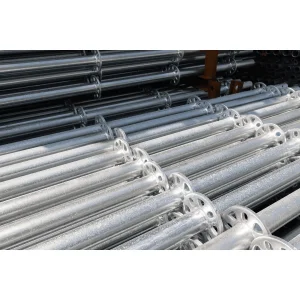
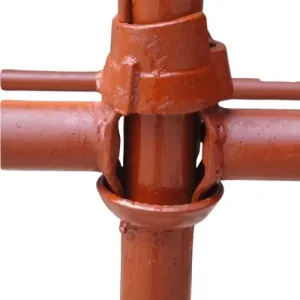
Core Value: Certified Quality, Proven Performance. The Ringlock scaffolding solutions developed by Zhuozhan Group have undergone extensive laboratory stress tests to comply with multiple international standards, including EN 12810/12811 and ISO 9001 certification standards.
Comprehensive layout of raw material processing and ecological protective measures
The production of vertical structural rods goes through five rigorous stages. To maintain modern green factory credentials, we tightly regulate carbon outputs, noise levels, and waste disposal at every step:
Similar to vertical members, horizontal ledger rods are processed systematically to guarantee reliable fitment during high-altitude erection:
Proving reliability across industrial megaprojects and dynamic architectural structures worldwide
Ringlock scaffolding inventory mass storage facilities and custom manufacturing tolerances.
Testing of self-locking design configurations under vertical loading.
Overview of Hebei Shuangyang facility operations and automated equipment line capacities.
Our scaffolding systems are engineered to withstand diverse geographic environments and demanding construction challenges:
Answers to crucial structural steel, load capacity, and logistical questions
 Zhuozhan