Choosing the right Scaffolding Materials is a practical decision, not a catalogue exercise. Global buyers compare steel, aluminium, timber, engineered wood, fibreglass, and composite systems. Each option behaves differently under load, weather, transport, and repeated assembly. A coastal project may need corrosion-resistant aluminium. A heavy masonry site may require galvanized steel frames. Lightweight components can reduce handling effort, but they may demand stricter bracing and connection checks.
Market data shows why this category deserves careful attention. Grand View Research valued the global scaffolding market at approximately USD 59.6 billion in 2023. Its report projects continued growth through 2030, supported by construction, infrastructure, and renovation activity. OSHA also reports that about 2.3 million construction workers use scaffolds in the United States. Historical OSHA estimates linked scaffold accidents with roughly 4,500 injuries and 50 deaths annually. These figures are not universal forecasts, but they reveal the stakes behind material selection.
Safety scientist Sidney Dekker states, “Safety is not the absence of accidents; it is the presence of capacity.” That principle applies directly to Scaffolding Materials. Buyers need more than tensile-strength figures. They should examine traceability, coating thickness, component compatibility, inspection records, and local standards. EN 12811-1 and OSHA requirements provide useful reference points, yet neither replaces competent engineering review. The uncomfortable truth is simple: the cheapest material may become expensive after corrosion, damage, delays, or replacement. This guide compares ten material types for global buyers, while acknowledging one limitation. Product performance can change significantly between manufacturers, even under the same material label.
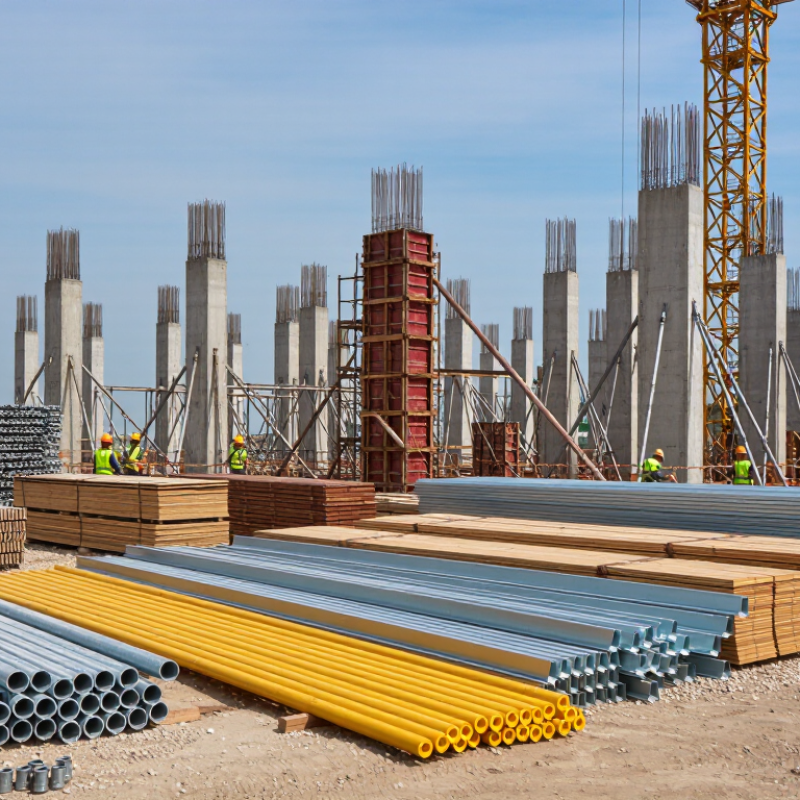
Top 10 Types of Scaffolding Materials for Global Buyers
Carbon steel, galvanized steel, stainless steel, and aluminum remain common choices for international scaffolding buyers. The correct material depends on load, weather, handling, and project duration. EN 12811-1 load classes range from 0.75 to 6.00 kN/m². These values describe working-platform loads, not a simple material ranking. A stronger-looking tube can still fail if connections, bracing, or foundations are poorly designed.
Carbon steel suits heavy-duty frames and high-load applications, but it needs reliable coating and regular inspection. Galvanized steel offers better resistance against rain, humidity, and storage damage. Stainless steel performs well near saltwater or aggressive industrial environments, although its price can limit large projects. Aluminum is lighter and easier to move between floors. However, it can suffer greater deformation under heavy loads. In site reviews, damaged boards and loose couplers often create more risk than the chosen metal. That point is easy to overlook.
Tips: Confirm the required EN 12811-1 load class before comparing prices. Request mill certificates, coating thickness records, weld inspection results, and dimensional tolerances. Check whether the supplier states working load or ultimate load. They are not the same. Also review local regulations, wind conditions, platform width, and anchoring details. A practical trial assembly can reveal fit problems early. It may feel slower, but it prevents costly corrections. Even experienced buyers sometimes accept attractive specifications without checking test evidence. That deserves a second look.
| No. | Scaffolding Material Type | Typical Grade or Construction | Approx. Density | Typical Minimum Yield Strength | Corrosion Resistance | Common Scaffolding Applications | Relevant EN 12811-1 Load Classes | Buyer Considerations |
|---|---|---|---|---|---|---|---|---|
| 1 | Painted Carbon Steel Tube | Structural carbon steel, commonly equivalent to S235-class tube; protective paint or powder coating | Approx. 7,850 kg/m³ | Approx. 235 MPa | Low without a coating; moderate when regularly maintained | Standards, ledgers, transoms, braces, frames, base components and access towers | 0.75, 1.50, 2.00, 3.00, 4.50 and 6.00 kN/m² | Cost-effective and widely weldable. Coating damage should be repaired to limit rust and section loss. |
| 2 | Hot-Dip Galvanized Carbon Steel | Carbon steel tube or fitting with a zinc coating applied after fabrication | Steel substrate: approx. 7,850 kg/m³ | Usually based on S235- or S355-class steel | High for normal outdoor exposure; zinc provides sacrificial protection | Tube-and-fitting scaffolds, system scaffolds, façade work and long-term outdoor projects | 0.75, 1.50, 2.00, 3.00, 4.50 and 6.00 kN/m² | Long service life with lower maintenance. Zinc coating thickness and post-galvanizing dimensional tolerances should be checked. |
| 3 | Electro-Galvanized Carbon Steel | Cold-formed or fabricated carbon steel with a thinner electroplated zinc layer | Steel substrate: approx. 7,850 kg/m³ | Commonly 235–355 MPa, depending on the steel grade | Moderate; generally lower outdoor durability than hot-dip galvanizing | Indoor scaffolding, light-duty frames, fittings and temporary construction equipment | 0.75, 1.50, 2.00 and 3.00 kN/m² are common; higher classes require system verification | Clean appearance and economical for sheltered use. Scratches and cut edges require additional protection. |
| 4 | Zinc-Rich Painted Carbon Steel | Carbon steel protected by zinc-rich primer and one or more compatible topcoats | Approx. 7,850 kg/m³ | Approx. 235–355 MPa, depending on the substrate | Moderate to high when the complete coating system is correctly applied | Heavy-duty frames, industrial maintenance scaffolds and projects requiring specified color coding | 0.75, 1.50, 2.00, 3.00, 4.50 and 6.00 kN/m² | Coating performance depends on surface preparation, dry-film thickness, impact resistance and repair procedures. |
| 5 | Austenitic Stainless Steel 304 | Cr-Ni stainless steel tube, sheet or fittings; typically annealed or cold-worked | Approx. 8,000 kg/m³ | Approx. 215 MPa in annealed condition | High in ordinary atmospheric environments; unsuitable conditions may cause staining or pitting | Food-processing areas, clean environments, architectural work and reusable specialist scaffolds | 0.75, 1.50, 2.00, 3.00, 4.50 and 6.00 kN/m² when engineered as a complete system | Good hygiene and appearance. Avoid contamination from carbon-steel tools and storage materials. |
| 6 | Austenitic Stainless Steel 316 | Cr-Ni-Mo stainless steel, with molybdenum improving resistance to chlorides | Approx. 8,000 kg/m³ | Approx. 205 MPa in annealed condition | Very high for marine and chloride-exposed environments, subject to correct design and cleaning | Marine construction, coastal infrastructure, chemical facilities and high-humidity work areas | 0.75, 1.50, 2.00, 3.00, 4.50 and 6.00 kN/m² when engineered as a complete system | Higher initial cost than 304 stainless steel, but improved resistance to chloride-related corrosion. |
| 7 | Aluminum Alloy 6061-T6 | Heat-treated aluminum alloy used for tubes, frames, decks and access towers | Approx. 2,700 kg/m³ | Approx. 240 MPa | High due to its natural oxide film; galvanic contact with dissimilar metals must be controlled | Mobile towers, suspended platforms, access systems and applications where low weight is important | 0.75, 1.50, 2.00 and 3.00 kN/m² are common; 4.50–6.00 kN/m² requires specific structural verification | About one-third the density of steel. Lower elastic modulus means greater deflection must be considered in design. |
| 8 | Aluminum Alloy 6082-T6 | Heat-treatable aluminum alloy frequently used for structural profiles and scaffold components | Approx. 2,700 kg/m³ | Approx. 250 MPa | High atmospheric corrosion resistance; crevices and galvanic couples require attention | Heavy-duty aluminum towers, beams, platforms, stair units and modular access systems | 0.75, 1.50, 2.00 and 3.00 kN/m² are common; higher classes require system-specific calculations | Good strength-to-weight ratio. Welding can reduce local strength in the heat-affected zone. |
| 9 | Aluminum Alloy 5052-H32 | Non-heat-treatable aluminum-magnesium alloy, commonly used for sheet and deck panels | Approx. 2,680 kg/m³ | Approx. 190 MPa | High atmospheric and marine corrosion resistance | Walkboards, deck panels, toe boards, guardrail panels and lightweight platform components | 0.75, 1.50 and 2.00 kN/m² are common; higher classes depend on span, stiffeners and verified testing | Lightweight and readily formed. Panel thickness, support spacing, slip resistance and local buckling are critical. |
| 10 | Structural Softwood Scaffold Boards | Graded spruce, pine or fir boards meeting the applicable structural timber requirements | Typically 400–550 kg/m³ | Strength depends on species, grade, moisture and defects | Low to moderate; requires protection from moisture, decay, splitting and prolonged weather exposure | Temporary working platforms, infill boards and traditional access arrangements where permitted | 0.75, 1.50 and 2.00 kN/m² are commonly achievable; higher classes require engineered sizing and verification | Inspect for knots, cracks, warping, decay and excessive moisture. Board dimensions and support spacing must be designed together. |
Technical note: EN 12811-1 load classes describe the uniformly distributed service load on the working area: Class 1 = 0.75 kN/m², Class 2 = 1.50 kN/m², Class 3 = 2.00 kN/m², Class 4 = 3.00 kN/m², Class 5 = 4.50 kN/m², and Class 6 = 6.00 kN/m². The applicable class is determined by the complete scaffold system, including tube or profile dimensions, connections, spans, bracing, decking, anchorage, wind actions and the design configuration; it cannot be assigned from material alone.
It should support its own weight plus four times the maximum intended load. This is only a safety baseline. It does not approve every design or location.
Yes, when the species, grain, grade, and moisture condition are suitable. Inspect knots, cracks, damaged edges, and wet surfaces. A clean-looking plank may still be weak.
Check its diameter, age, splits, treatment, and visible damage. Small cracks can affect load performance. Do not judge strength by appearance alone.
Engineered wood usually offers consistent dimensions. However, cut ends and directional strength need careful review. A factory certificate may not prove safe field use.
Not automatically. Buyers must check local construction codes, worker protection rules, and engineering requirements. The assembled scaffold needs proper review.
Request load tables, material grades, moisture limits, and inspection records. Ask whether testing covered the complete scaffold system. One tested component proves very little.
Their non-conductive structure can reduce electrical exposure near energized equipment. It does not remove every hazard. Wet surfaces, metal tools, and damaged resin still matter.
Match the rating to workers, tools, stored materials, and movement. Light maintenance differs from heavy industrial work. Check the complete assembled scaffold, not one frame.
Lightweight components can pass through narrow corridors and raised platforms more easily. They may reduce handling strain. Lighter does not mean weaker.
Recheck the scaffold after rain, impact, or relocation. Inspect base plates, joints, platforms, and uneven ground. Wind exposure deserves attention too. Paper calculations can miss real problems.
Choosing the right Scaffolding Materials is essential for safe, efficient, and cost-effective work across different regions and climates. This guide compares carbon steel, galvanized steel, stainless steel, and aluminum against EN 12811-1 load classes ranging from 0.75 to 6.00 kN/m². It also examines timber, bamboo, and engineered wood using OSHA’s benchmark that components should support at least four times the intended load. Each material is assessed for strength, corrosion resistance, weight, service life, and suitability for indoor or outdoor applications.
The overview also explains how fiberglass and FRP systems can improve electrical safety while reducing weight, provided their duty class and load ratings are properly verified. Plastic and composite systems require careful evaluation of UV resistance, fire performance, and structural durability. A practical global buyer selection matrix helps match all ten material types with EN or OSHA requirements, project loads, environmental conditions, maintenance expectations, and regional climate needs.

 Zhuozhan